For the past 250 years, books have been fundamental instruments through which we preserve, interpret, and engage in American history as an ongoing practice of free expression.
"This Day” is partnering with Random House to bring you a special, month-long series called “A Nation of Readers.” In this series, we’ll hear from an all-star cast of authors—all published by Random House—about how books and publishing shape and reshape American history.
Listen to "A Nation of Readers" in the
"This Day" Podcast Feed
"This Day" Podcast Feed
Episode 1 - Isabel Wilkerson + Tara Westover
Our first episode features an original audio essay from Isabel Wilkerson on the importance of uncovering and bearing witness to history, paired with an expansive conversation with Tara Westover about how our historical education informs and reshapes who we are.
Episode 2 - Nate DiMeo's Memory Palace
Our second episode features an original story from Nate DiMeo, podcast host and author of "The Memory Palace", who weaves research, scoring, and exquisite prose into readings of historical tales.
Episode 3 - The Gaps In History
For many historians, interpreting the raw materials of history requires learning to read between the lines. In conversation with historians Tiya Miles, author of "All That She Carried", and Kathleen DuVal, author of "Native Nations", our latest episode explores how to find historical inspiration within and outside the written archive.
Episode 4 - Poem, Essay, Hanif Abdurraqib & Javier Zamora
Hanif Abdurraqib and Javier Zamora both float between poetry, memoir, essay, spoken word and more -- finding the right form to explore their personal experience within American history. They join Jody Avirgan to discuss their work and its impact.
Episode 5 - The Books That Shaped America with Jon Meacham
In a 2-part special, "This Day" hosts and Pulitzer Prize-winning presidential historian Jon Meacham take a 250-year tour of influential history books.
Episode 6 - Books We'd Save From A Fire (Part 2) with Jon Meacham
Our 250 year tour of influential history books continues in this series finale.
BOOKS FEATURED ON "A Nation of Readers"
Random House titles are available wherever books are sold.

A Little Devil in America
“I was a devil in other countries, and I was a little devil in America, too.” Inspired by these few words, spoken by Josephine Baker at the 1963 March on Washington, MacArthur “Genius Grant” Fellow and bestselling author Hanif Abdurraqib has written a profound and lasting reflection on how Black performance is inextricably woven into the fabric of American culture. Each moment in every performance he examines—whether it’s the twenty-seven seconds in “Gimme Shelter” in which Merry Clayton wails the words “rape, murder,” a schoolyard fistfight, a dance marathon, or the instant in a game of spades right after the cards are dealt—has layers of resonance in Black and white cultures, the politics of American empire, and Abdurraqib’s own personal history of love, grief, and performance.
Touching on Michael Jackson, Patti LaBelle, Billy Dee Williams, the Wu-Tan Clan, Dave Chappelle, and more, Abdurraqib writes prose brimming with jubilation and pain. With care and generosity, he explains the poignancy of performances big and small, each one feeling intensely familiar and vital, both timeless and desperately urgent. Filled with sharp insight, humor, and heart, A Little Devil in America exalts the Black performance that unfolds in specific moments in time and space—from midcentury Paris to the moon, and back down again to a cramped living room in Columbus, Ohio.
Listen to a Sample from A Little Devil in America
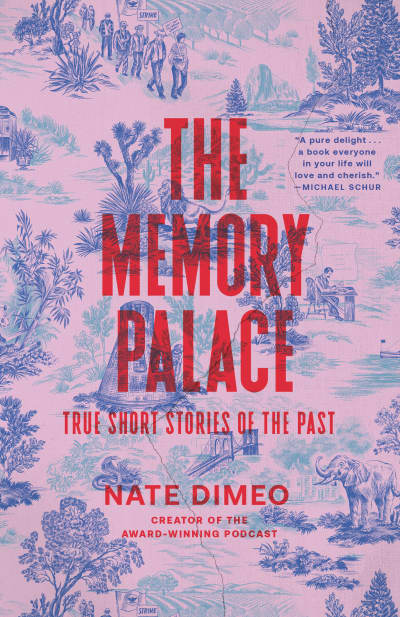
The Memory Palace
Incredible true stories reveal strange new magic in American history in this wondrous first book from the creator of the award-winning podcast The Memory Palace.
The Memory Palace is a collection of crystalline historical tales that read like luminous short fiction and, like Nate DiMeo’s acclaimed podcast of the same name, conjure lost moments and forgotten figures who are calling out across time to be remembered.
Space capsules filled with fruit flies and future senators. A socialite scientist who gives up her glamorous life to follow love and the elusive prairie chicken. A boy genius on a path to change the world who gets lost in the theoretical possibilities of streetcar transfers. An enslaved man who steals a boat and charts a course that leads him to freedom, war, and Congress. A farmer’s wife who puts down her butter churn, picks up the butter, and becomes an international art star. An amusement park glowing at the water’s edge when electric lights are a brand-new thing. This cabinet of curiosities teems with wonder.
For fifteen years, Nate DiMeo has turned to the past to make sense of the way we live today, finding beauty and meaning in history’s dustier corners, holding things up to the light and weaving facts, keen insight, wit, and poignant observation into unforgettable tales. With new stories and treasured favorites from the beloved podcast assembled alongside dynamic illustrations and archival photographs for the first time, enchantment awaits you.

Native Nations
Long before the colonization of North America, Indigenous Americans built diverse civilizations and adapted to a changing world in ways that reverberated globally. And, as award-winning historian Kathleen DuVal vividly recounts, when Europeans did arrive, no civilization came to a halt because of a few wandering explorers, even when the strangers came well armed.
A millennium ago, North American cities rivaled urban centers around the world in size. Then, following a period of climate change and instability, numerous smaller nations emerged, moving away from rather than toward urbanization. From this urban past, egalitarian government structures, diplomacy, and complex economies spread across North America. So, when Europeans showed up in the sixteenth century, they encountered societies they did not understand—those having developed differently from their own—and whose power they often underestimated.
For centuries afterward, Indigenous people maintained an upper hand and used Europeans in pursuit of their own interests. In Native Nations, we see how Mohawks closely controlled trade with the Dutch—and influenced global markets—and how Quapaws manipulated French colonists. Power dynamics shifted after the American Revolution, but Indigenous people continued to command much of the continent’s land and resources. Shawnee brothers Tecumseh and Tenskwatawa forged new alliances and encouraged a controversial new definition of Native identity to attempt to wall off U.S. ambitions. The Cherokees created institutions to assert their sovereignty on the global stage, and the Kiowas used their power in the west to regulate the passage of white settlers across their territory.
In this important addition to the growing tradition of North American history centered on Indigenous nations, Kathleen DuVal shows how the definitions of power and means of exerting it shifted over time, but the sovereignty and influence of Native peoples remained a constant—and will continue far into the future.

American Struggle
The author of The Soul of America unites centuries of essential American voices to understand our national debates and divisions from 1619 to the present, with his signature commentary on the consequential speeches, letters, and essays that led us to this moment.
In a polarized era, history can become a subject of political contention. Many see America as perfect; many others argue that the national experiment is fundamentally flawed. The truth, Meacham shows, likely lies between these extremes. America has had shining hours, and also dark ones.
In American Struggle, Jon Meacham illuminates the nation’s complicated past. This rich and diverse collection covers a wide spectrum of history, from 1619 to the twenty-first century, with primary-source documents that take us back to critical moments in which Americans fought over the meaning and the direction of the national experiment. From the founders to Lincoln to Obama, from Andrew Jackson to Theodore Roosevelt to Ronald Reagan, from Seneca Falls to the March on Washington, this chorus—sometimes discordant and always fascinating—tells the story of the country and of its people. As clashes over liberty and slavery, inclusion and exclusion, play out, these voices, brilliantly framed by Meacham’s singular commentary, remind us that contentious citizenship and fair-minded observations are essential to bringing about the more perfect union envisioned in the Preamble to the Constitution, which Frederick Douglass called a “glorious liberty document.”
Conflict is nothing new in our democracy; rather, as Meacham and these texts show, tensions are inherent, stubborn, and perennial. And American Struggle teaches us anew that to know what has come before, to watch as long-running disputes rise and fall, is to be armed against despair.
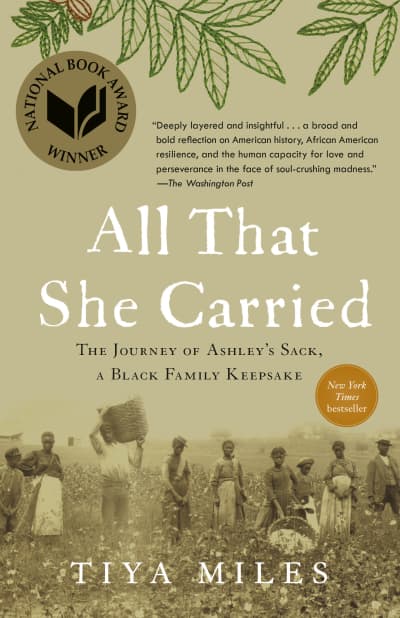
All That She Carried
A renowned historian traces the life of a single object handed down through three generations of Black women to craft a “deeply layered and insightful” (The Washington Post) testament to people who are left out of the archives.
In 1850s South Carolina, an enslaved woman named Rose faced a crisis: the imminent sale of her daughter Ashley. Thinking quickly, she packed a cotton bag for her with a few items, and, soon after, the nine-year-old girl was separated from her mother and sold. Decades later, Ashley’s granddaughter Ruth embroidered this family history on the sack in spare, haunting language.
Historian Tiya Miles carefully traces these women’s faint presence in archival records, and, where archives fall short, she turns to objects, art, and the environment to write a singular history of the experience of slavery, and the uncertain freedom afterward, in the United States. All That She Carried is a poignant story of resilience and love passed down against steep odds. It honors the creativity and resourcefulness of people who preserved family ties when official systems refused to do so, and it serves as a visionary illustration of how to reconstruct and recount their stories today.

The Warmth of Other Suns
In this beautifully written masterwork, Pulitzer Prize–winning author Isabel Wilkerson presents a definitive and dramatic account of one of the great untold stories of American history: the Great Migration of six million Black citizens who fled the South for the North and West in search of a better life, from World War I to 1970.
Wilkerson tells this interwoven story through the lives of three unforgettable protagonists: Ida Mae Gladney, a sharecropper’s wife, who in 1937 fled Mississippi for Chicago; sharp and quick-tempered George Starling, who in 1945 fled Florida for Harlem, and Robert Foster, a surgeon who left Louisiana in 1953 in hopes of making it in California.
Wilkerson brilliantly captures their first treacherous cross-country journeys by car and train and their new lives in colonies in the New World. The Warmth of Other Suns is a bold, remarkable, and riveting work, a superb account of an “unrecognized immigration” within our own land. Through the breadth of its narrative, the beauty of the writing, the depth of its research, and the fullness of the people and lives portrayed herein, this book is a modern classic.

Caste
The Pulitzer Prize-winning author of The Warmth of Other Suns examines the unspoken caste system that has shaped America and shows how our lives today are still defined by a hierarchy of human divisions—now with a new afterword by the author.
“As we go about our daily lives, caste is the wordless usher in a darkened theater, flashlight cast down in the aisles, guiding us to our assigned seats for a performance. The hierarchy of caste is not about feelings or morality. It is about power—which groups have it and which do not.”
Beyond race, class, or other factors, there is a powerful caste system that influences people’s lives and behavior and the nation’s fate. Linking the caste systems of America, India, and Nazi Germany, Isabel Wilkerson explores eight pillars that underlie caste systems across civilizations, including divine will, bloodlines, stigma, and more. Using riveting stories about people—including Martin Luther King, Jr., baseball’s Satchel Paige, a single father and his toddler son, Wilkerson herself, and many others—she shows the ways that the insidious undertow of caste is experienced every day. Finally, she points forward to ways America can move beyond the artificial and destructive separations of human divisions, toward hope in our common humanity.
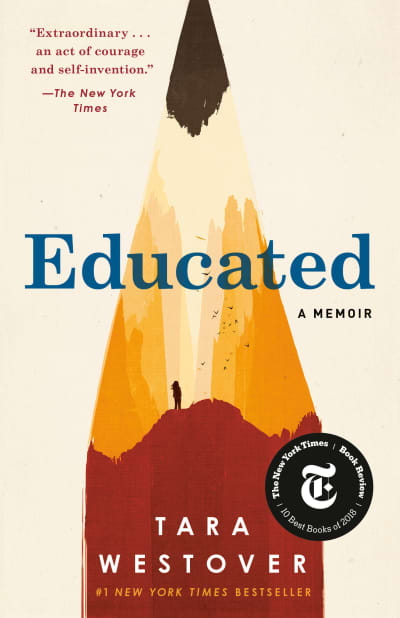
Educated
One of the most acclaimed books of our time: an unforgettable memoir about a young woman who, kept out of school, leaves her survivalist family and goes on to earn a PhD from Cambridge University
Born to survivalists in the mountains of Idaho, Tara Westover was seventeen the first time she set foot in a classroom. Her family was so isolated from mainstream society that there was no one to ensure the children received an education, and no one to intervene when one of Tara’s older brothers became violent. When another brother got himself into college, Tara decided to try a new kind of life. Her quest for knowledge transformed her, taking her over oceans and across continents, to Harvard and to Cambridge University. Only then would she wonder if she’d traveled too far, if there was still a way home.
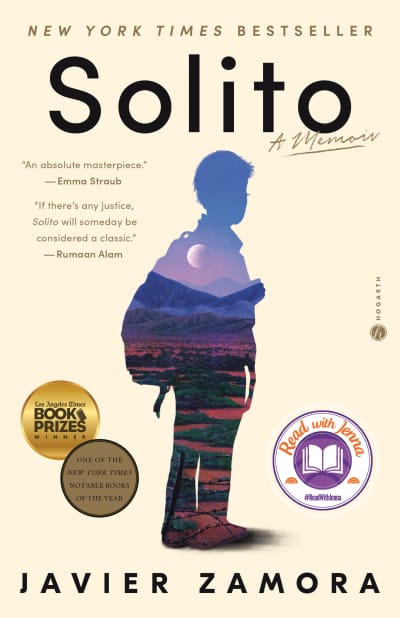
Solito: A Read with Jenna Pick
"Trip. My parents started using that word about a year ago—'one day, you’ll take a trip to be with us. Like an adventure.'"
Javier Zamora’s adventure is a three-thousand-mile journey from his small town in El Salvador, through Guatemala and Mexico, and across the U.S. border. He will leave behind his beloved aunt and grandparents to reunite with a mother who left four years ago and a father he barely remembers. Traveling alone amid a group of strangers and a “coyote” hired to lead them to safety, Javier expects his trip to last two short weeks.
At nine years old, all Javier can imagine is rushing into his parents’ arms, snuggling in bed between them, and living under the same roof again. He cannot foresee the perilous boat trips, relentless desert treks, pointed guns, arrests and deceptions that await him; nor can he know that those two weeks will expand into two life-altering months alongside fellow migrants who will come to encircle him like an unexpected family.
A memoir as gripping as it is moving, Solito provides an immediate and intimate account not only of a treacherous and near-impossible journey, but also of the miraculous kindness and love delivered at the most unexpected moments. Solito is Javier Zamora’s story, but it’s also the story of millions of others who had no choice but to leave home.
Listen to a Sample from Solito: A Read with Jenna Pick
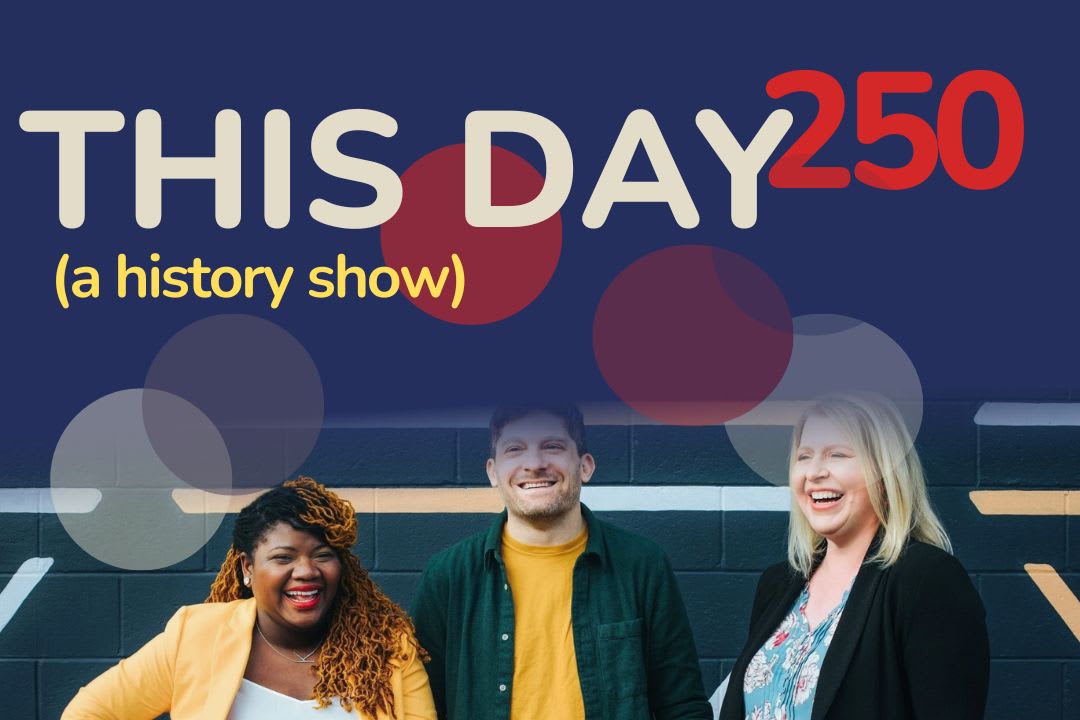
"This Day" takes you beyond the head-spinning headlines of today and into the unexpected historical moments that have shaped American politics and culture. Hosted by Jody Avirgan (538), and historians Nicole Hemmer (Vanderbilt), and Kellie Carter Jackson (Wellesley), each episode explores a moment from that day in U.S. political history to uncover its lasting impact.
On Sunday episodes, Jody, Niki and Kellie react to current news with their usual mix of humor, analysis, and historical perspective. New episodes released Tuesdays, Thursdays, and Sundays. Lots more on our Instagram page, YouTube, and newsletter. Find it all at thisdaypod.com.
This Day is a proud member of the Radiotopia podcast network from PRX.